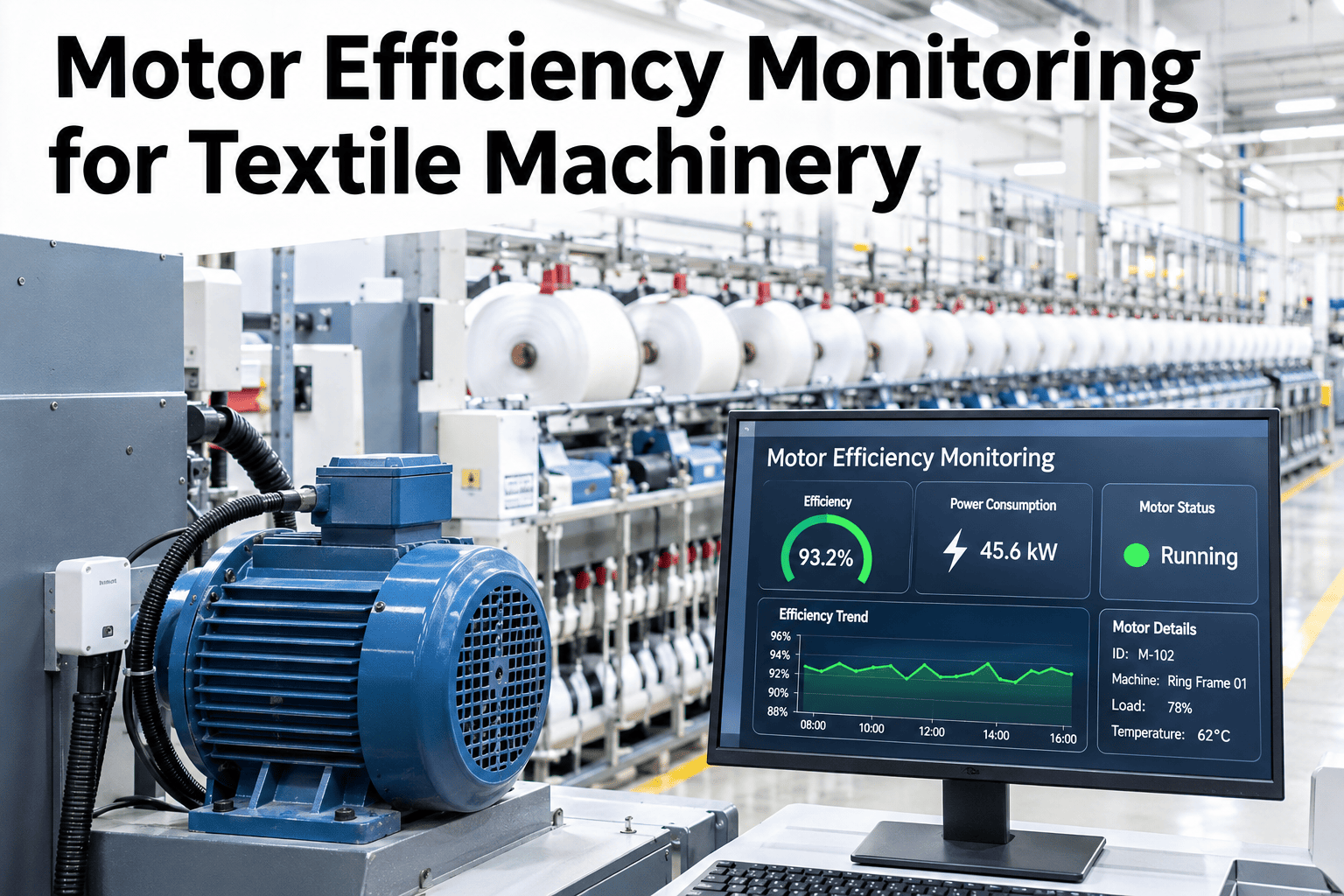
Motor efficiency monitoring for textile machinery means metering the power each motor draws, comparing it with the motor's rating and the output it produces, then flagging drives that run underloaded, idle or above their kWh per kg target. iFactory, an on-premise industrial AI platform, turns those readings into one ranked list per shift. See it on real machines in a live demo.
Motor Efficiency Monitoring for Textile Machinery
Put every spindle, comber, winder and loom drive on one loading ruler. See which motors sit in the efficient band, which sit idle, and which add kWh to every kilogram of yarn.
What is motor efficiency monitoring in a textile mill?
It is the continuous measurement of each motor's electrical input, loading percentage, power factor and idle time, tied to the production that motor drives. The goal is simple: find the drives where kWh per kilogram runs above what the process needs, then fix those first. Start with the numbers that explain why motors deserve attention, and see the method applied to your own floor.
Which four readings show that a motor is wasting energy?
Four readings, taken together, separate a healthy drive from a wasteful one. Each is cheap to measure once the meter exists.
Loading percentage
Measured input kW divided by input kW at rated load. Efficiency falls sharply once a motor runs well below about 50% (U.S. DOE).
Power factor
Falls as load falls, because magnetizing current stays constant. A low reading on a drive points to a lightly loaded motor.
Idle kW share
Energy drawn while the machine produces nothing: waiting for sliver, doffing, a jammed line, or a drive left running between lots.
kWh per kg
Machine energy divided by output at the same yarn count. It is the one figure that compares unlike machines fairly.
How do you calculate motor loading from a power meter?
Use measured input kilowatts whenever you have them. The U.S. Department of Energy's motor load fact sheet gives the kilowatt-ratio method, and it stays valid at any load level. Three lines are enough, and the support desk can share a worked spreadsheet.
Which loading band is each motor in, and what should you do?
Most motors are designed for 50% to 100% of rated load, with peak efficiency near 75% (U.S. DOE). Sort every motor into one of five bands, then act on the band, not on a hunch. A demo session shows the ranking on one screen.
Nameplate IE class says
Efficiency at the rated point only. The IEC 60034-30 classes ignore partial-load efficiency. In the EU, IE3 is the minimum for 0.75–75 kW motors and IE4 for 75–200 kW (NORD summary of Regulation 2019/1781).
Measured loading says
What the motor really does on your frame, at your yarn count. A premium-efficiency motor at 30% load is still a poor fit; a standard one near 75% may be performing well.
How do you find idle running on spinning and weaving machines?
Idle share is the kWh drawn while the output counter reads zero, divided by total kWh. It needs a production signal beside the meter. Mills often find ring frames of the same count differing by more than 10% in kWh, and worn tin roller bearings are one named cause (Fibre2Fashion). Thermal imaging and vibration checks confirm it, and support engineers can help wire the signal.
A Fibre2Fashion practitioner guide suggests fitting a kWh meter to any motor above 5 hp that runs two shifts. It also shows how a ring frame motor averaging about 50% of rating can justify a smaller IE3 unit, while one loaded at 60% to 80% should keep its size.
Which of your motors is idling right now?
Bring one shift of meter data. iFactory ranks every drive by loading band and idle share, so maintenance knows where to look first.
What is a good kWh per kg, and how do you compare machines?
Compare within the same yarn count and shift pattern, because finer counts draw more energy per kilogram. Energy is about 12% to 13% of ring spinning cost (Tekstil ve Mühendis), so a few percent matters. Treat the figures below as published reference points, and set your own targets from baseline data.
How do you roll out motor monitoring in four steps?
Start with the drives that matter most and keep the first pass small. The sequence below works for a spinning hall or a weaving shed.
Meter the biggest drives
Motors above 5 hp on two shifts first, then compressors and fans that serve them.
Baseline for two weeks
Record loading, power factor, idle share and kWh per kg by count and shift.
Rank by wasted kWh
Multiply the gap to target by running hours. Work the top five, not all fifty.
Fix, then re-measure
Stop idling, correct bearings and belts, apply a VFD or resize at failure, then confirm the saving.
Limits are worth stating. Monitoring finds the loss but does not remove it. Savings from a variable frequency drive depend on the load profile, and meter placement determines how trustworthy every ratio is.
How does iFactory deliver motor monitoring on-premise?
iFactory ships a pre-configured NVIDIA AI server, racked and ready, with software pre-loaded. Rack it, plug in power and Ethernet, and the AI is live. Scope covers cabling, network, PLC and SCADA integration, operator training and 24×7 remote monitoring, and plant data stays on site. Ask for a pilot call to size yours.
Ship, network, data
Server arrives, meters and PLC tags connect.
Train and pilot
Loading bands and idle share validated on a pilot hall.
Go live and train
Plant-wide ranking, alerts and operator training.
Frequently asked questions
What loading percentage means a textile motor is underloaded?
Most motors are designed to run between 50% and 100% of rated load, so a drive that sits below about 40% is a review candidate. Below 10% it is effectively idling. Measure with input kilowatts first, then book a walkthrough to see the ranked list on your own meters.
Can I monitor motor efficiency without replacing existing meters?
Usually yes. iFactory reads existing energy meters, drive data and PLC or SCADA tags, and adds clamp-on current sensors only where a motor has no signal. A short scoping call maps which drives are already covered, and the support desk can advise on sensor placement.
Is replacing an oversized motor always worth it?
Not always. Research on IE3 and IE4 motors found oversizing is often not cost effective, and DOE notes larger motors stay efficient down to about 25% load. The best moment to resize is when a motor fails. Talk through candidates with a specialist before spending.
How is idle running different from low loading?
Low loading is a sizing issue: the motor is working, just far below its rating. Idle running is a scheduling or control issue: the motor is energized while the machine makes nothing. They need different fixes, and a demo session shows both on one screen.
How long does iFactory take to go live on textile machinery?
A typical turnkey rollout runs 6 to 12 weeks: ship and network, train and pilot, then go live with operator training. The server arrives pre-configured, so your team racks it and connects power and Ethernet. Plan your pilot or ask the team about your site.
Put every textile motor on the ruler
Get a turnkey on-premise setup that measures loading, idle share and kWh per kg, live in 6 to 12 weeks.