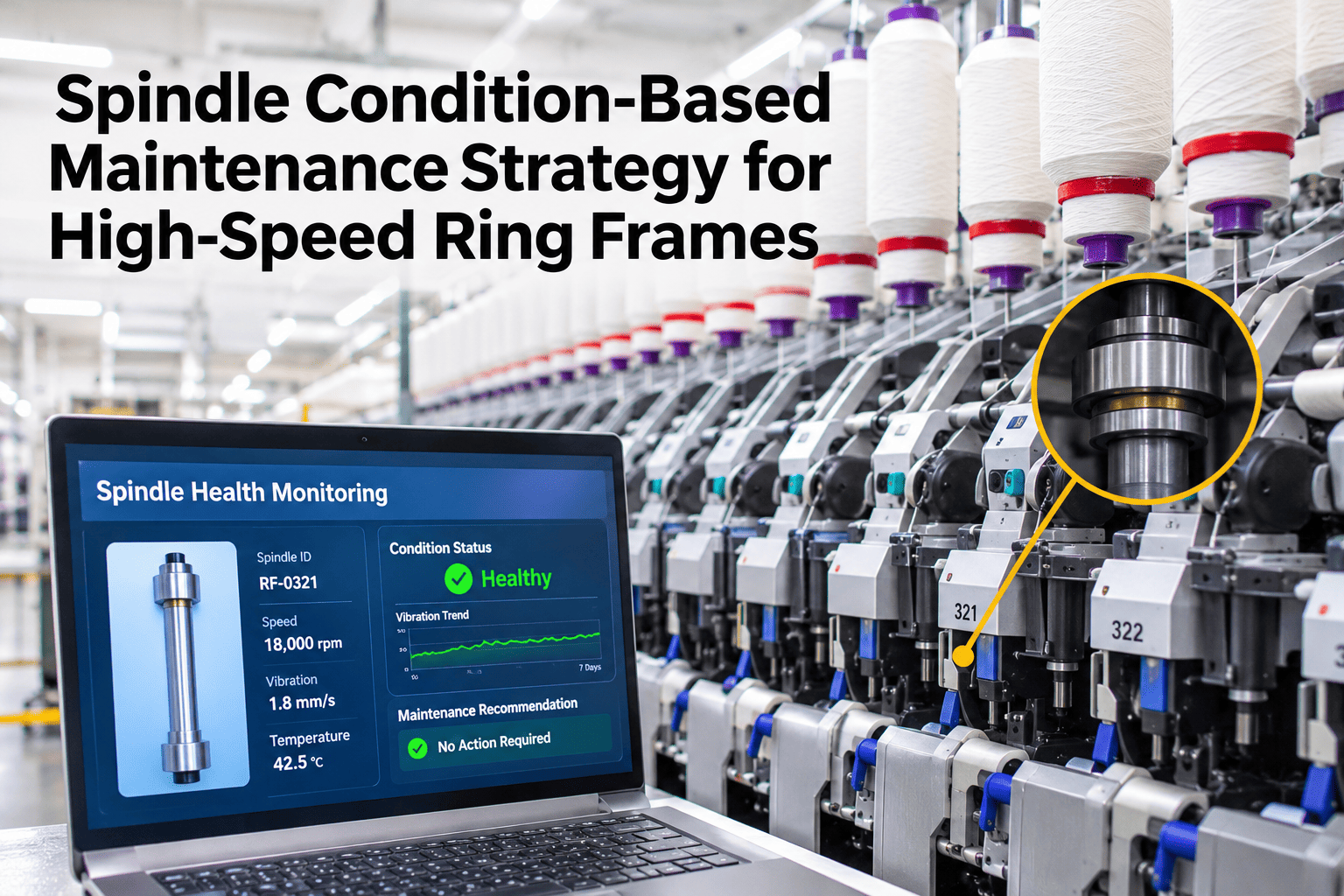
High-speed ring frames running at 18,000–24,000 rpm place bearing, bolster and spindle tip components under mechanical loads that make calendar-based maintenance schedules a poor fit. A bolster oil service every three months works reasonably well for a frame running Ne 20 at 16,000 rpm — but the same interval on a frame running Ne 60 at 22,000 rpm is likely too long, while the same interval on a frame running light orders at reduced speed may be too short on cost and unnecessary on condition. Condition-based maintenance replaces the calendar with evidence: spindle vibration, temperature, failure history and quality signals determine when each spindle position actually needs service, rather than when the interval says it does. The result is fewer unplanned failures, fewer unnecessary services, and a maintenance team spending its time on the spindles that need attention rather than the spindles whose service date has passed. Teams that want to see this strategy built for their own fleet can book a session with iFactory AI.
Replace the Spindle Service Calendar With a Condition-Driven Maintenance Strategy
iFactory AI builds a condition-based maintenance strategy for ring frames using spindle vibration, temperature, failure history and quality signals — prioritising by risk, not by date.
What Is Condition-Based Maintenance for Spindles?
Condition-based maintenance (CBM) for spindles is a maintenance strategy in which service decisions are triggered by measured evidence of component deterioration — vibration trending toward a threshold, temperature deviation beyond baseline, yarn break rate increasing on specific positions — rather than by the passage of a fixed time interval since the last service.
For ring spinning spindles, CBM is a natural fit because the dominant failure mode — bearing wear — produces measurable leading signals well in advance of failure, and because the rate of bearing wear varies significantly with spindle speed, count, raw material, running temperature and lubrication frequency. Rieter's sensor-based predictive maintenance reports a 95% accuracy rate in predicting failures and a 15% reduction in maintenance costs for spinning machines using condition-based approaches (Textile School, 2025). The strategy does not replace preventive maintenance entirely — it refines the interval and adds condition-triggered interventions between scheduled services where the evidence justifies them.
The Four Signals That Drive the Condition-Based Strategy
A condition-based strategy for high-speed ring frames combines four signal types. Each adds a different dimension; the strategy is most effective when all four are connected in one decision layer.
Stop Servicing Spindles on Interval — Start Servicing Them on Evidence
iFactory AI builds the condition-based maintenance strategy for your ring frame fleet — combining vibration, temperature, failure history and quality signals into a daily service priority list that reduces unplanned failures and unnecessary services simultaneously.
Building the Strategy: Implementation Sequence
A condition-based maintenance strategy is not deployed all at once — it is built in stages, with each stage adding a more sophisticated decision layer on top of the previous one.
Maintenance Strategy Comparison for High-Speed Ring Frames
| Attribute | Reactive | Time-Based PM | Condition-Based (iFactory AI) |
|---|---|---|---|
| Service trigger | Failure event | Fixed interval | Condition threshold crossed |
| Unplanned failures | High — by design | Moderate — gaps between intervals | Low — interventions timed to condition |
| Unnecessary services | None | High — services on healthy spindles | Low — only when condition indicates need |
| High-speed frame fit | Poor | Partial — interval accuracy degrades at high speed | High — condition-driven is speed-agnostic |
| Implementation effort | None | Low | Moderate — requires sensor and data infrastructure |
Frequently Asked Questions
Does condition-based maintenance eliminate the need for a preventive maintenance schedule?
No — it refines it. The preventive schedule remains as a safety net for components and failure modes that do not produce detectable leading signals. CBM adds condition-triggered interventions between scheduled services and adjusts intervals based on evidence. A combined PM+CBM strategy outperforms either approach alone. See how the combined strategy is structured for a typical ring frame fleet.
How does the strategy handle spindles where sensor coverage is not yet installed?
For spindle positions without individual sensors, the strategy uses frame-level vibration, break rate trends, and maintenance history as proxy signals — producing a lower-resolution risk estimate that improves when individual sensors are added. iFactory AI identifies which unmonitored positions most need sensor coverage from the existing data. Ask our team how sensor coverage gaps are managed in the risk model.
What is the typical maintenance cost reduction from switching to condition-based maintenance?
Rieter reports a 15% maintenance cost reduction from condition-based approaches on spinning machines (Textile School, 2025). The reduction comes from two directions: fewer reactive repair costs (which run 3–5× the cost of planned services) and fewer unnecessary planned services on healthy components. Book a session to estimate the saving from your current maintenance spend.
How is the strategy adjusted when the production programme changes — different counts, different speeds?
The condition thresholds and risk model adjust automatically when the production record shows a count or speed change on a frame — because the baseline vibration and temperature at a different speed are different. iFactory AI tracks the active speed and count per frame and applies the appropriate baseline for threshold comparison. Ask our team how count and speed changes are handled in the threshold model.
Can the strategy be applied to compact spinning frames as well as standard ring frames?
Yes. Compact spinning frames have additional components — suction tubes, condensers, perforation rollers — that add specific failure modes to the standard ring frame list. iFactory AI includes compact-specific condition signals in the strategy for mills running compact systems. See how compact spinning components are included in the condition-based model.
Build a Maintenance Strategy That Fits Your Spindles — Not Your Calendar
iFactory AI builds the condition-based maintenance strategy for high-speed ring frames from vibration, temperature, failure history and quality signals — reducing unplanned failures and unnecessary services at the same time. Book a session built around your fleet data.