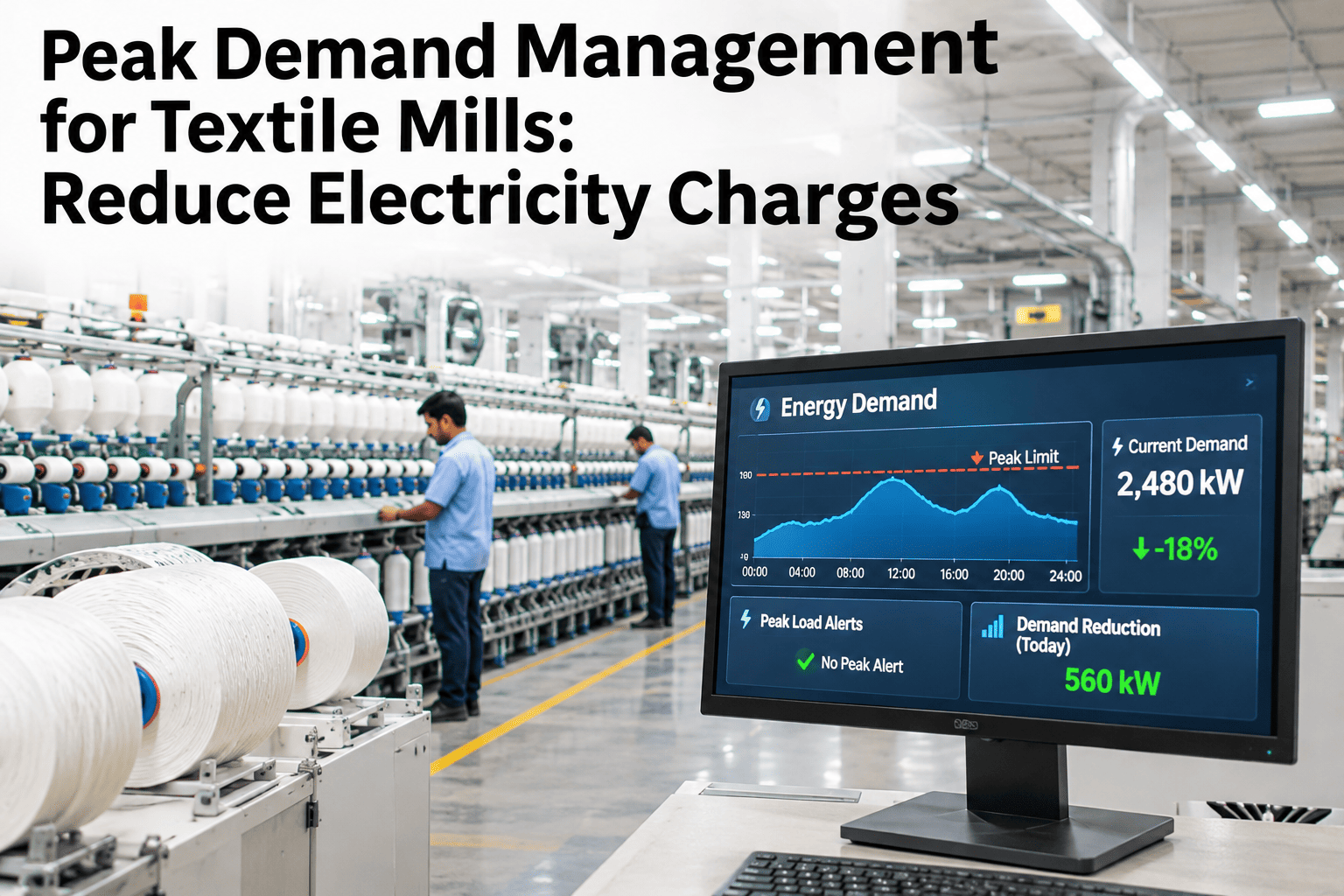
Most textile mills treat peak demand management as a monitoring problem — watch the curve, get an alert, react. The real constraint sits earlier: not every process can shift its load timing without risking quality or a shipment, and few mills map which ones can before the charge is locked in. Spinning runs on a continuous spindle load that cannot pause without yarn damage, while a dyeing batch's thermal soak can often be nudged thirty minutes with no quality consequence. The question worth answering first is not when the peak happened but which of your own processes could have moved to avoid it.
Can This Process Actually Shift? Score Every Load Before You Touch the Demand Curve
A peak demand charge is set by one bad fifteen-minute interval, but the fix isn't shaving the peak after the fact — it's knowing in advance which processes are free to move.
Why "Can You Shift It" Matters More Than "When Did It Spike"
A demand charge is set by the single highest average kW draw in one fifteen-minute billing interval, and it locks in the month's demand rate. Most demand-management advice stops at detecting that interval and alerting someone — it never asks which loads inside the spike were actually free to move without damaging product or missing a delivery. In a textile mill that answer differs by department, which is why treating all load as equally movable stalls most demand-reduction attempts.
- Spinning is tied to continuous spindle rotation and yarn tension; interrupting it mid-run risks breakage and uneven twist.
- Weaving has fixed loom cycle times per pick but some flexibility at batch changeover between styles.
- Dyeing and finishing run on scheduled thermal cycles with soak and hold times that can often tolerate a shifted start.
That asymmetry is the actual shiftability problem, and it's the gap between knowing your demand curve and being able to do something about it.
What Is a Shiftability Score, and Why Every Load Needs One
A shiftability score rates how much a load's timing can move without breaching a quality, safety, or delivery constraint. It is a constraint map built process by process — a dye batch and a ring frame fail differently if you get it wrong.
Spinning (Ring Frame / Rotor)
Continuous load proportional to spindle speed. Stopping mid-run risks yarn breakage and twist inconsistency — timing is fixed by the production order.
Weaving
Loom cycle time is fixed while running, but batch changeovers create windows where a start can delay 10–20 minutes with no output loss.
Dyeing, Finishing & Stentering
Thermal soak and hold cycles carry built-in slack. A heating cycle delayed 20–40 minutes rarely changes the outcome if hold temperature and duration are preserved.
Shiftability by Process, Side by Side
Comparing departments on one scale turns "should we try demand management" into "which process do we start with."
| Process | Load Character | Typical Shift Window | Primary Risk if Forced |
|---|---|---|---|
| Spinning (Ring Frame) | Continuous, speed-proportional | None during a run | Yarn breakage, twist defects |
| Weaving | Cyclical, fixed per pick | 10–20 min at changeover | Missed takt, loom idle cost |
| Dyeing (Batch) | Thermal, soak-and-hold | 20–40 min at cycle start | Shade variation if hold time cut |
| Finishing / Stentering | Thermal, continuous width control | 15–30 min at batch start | Moisture regain drift, shrinkage |
| Compressed Air / HVAC | Support load, not product-tied | Minutes, with buffer | Pressure drop, humidity drift |
Building a Shift Plan: What Has to Be True Before You Move Anything
A shift plan only works if it respects the constraint that made a process unshiftable in the first place — a dye batch's start moves only within bounds that keep hold temperature and duration intact; a loom restart moves only at changeover.
- Every process is tagged with a shiftability tier — fixed, partial, or flexible — before any load-scheduling logic touches it.
- Shift windows are defined in process terms (changeover gaps, soak-cycle slack), not generic time blocks borrowed from other industries.
- Quality-critical parameters — hold temperature, hold duration, takt time — are locked as hard constraints.
- Every automated shift recommendation stays visible and reversible, never a silent background action.
- The plan re-scores whenever the schedule changes, since a style change can turn a flexible window into a fixed one overnight.
Find Out Which of Your Loads Can Actually Move
A fifteen-minute walkthrough of your own interval data, scored process by process, shows exactly where the safe shift windows are.
Why This Differs From Generic Demand Response
Generic demand-response guidance treats load as one pool to shed or stage, without much regard for what's actually running. That works for HVAC setback or a standby compressor, but it breaks down on a spinning floor or an active dye batch — the cost of an interruption isn't just energy, it's a ruined lot.
Shed or Stage, Uniformly
Non-critical loads dropped near a threshold, with little distinction between an HVAC zone and a mid-cycle dye batch.
Shift Only What's Scored Flexible
Each load carries a pre-assigned tier tied to its actual process constraint, so the system never proposes moving something it shouldn't.
Savings Without the Quality Risk
Load reduction is formulated as a constrained problem — minimizing peak demand while respecting throughput, temperature, and cycle-time limits.
What iFactory Builds for Mills Running This
iFactory ties equipment-level sub-metering to the production schedule so load, process stage, and shiftability tier live in one system, not three disconnected spreadsheets.
Process-Level Tiering
Every monitored asset carries a shiftability tier tied to its actual production constraint, not a department-wide guess.
Live Re-Evaluation
Tiers update automatically as the schedule changes, so a flexible window isn't treated as flexible after it's gone.
Supervisor-Visible Recommendations
Any load tied to a committed sequence, customer deadline, or quality-critical process is excluded by default, and every recommendation stays visible and overridable before it takes effect.
Most demand-reduction programs fail quietly in month two, not because the technology stops working but because the load list was never scored against what each process can tolerate. A spinning floor and a dye house are not interchangeable kilowatts — treat them that way for a few billing cycles and the savings evaporate.
Get Your Process-by-Process Shift Map
Send a month of interval data and get back a scored breakdown of which loads are fixed, partial, and flexible.
Frequently Asked Questions
What is a shiftability score in textile demand management?
A shiftability score rates how far a process's load timing can move without breaching a quality or delivery constraint. Spinning scores fixed, weaving partially flexible at changeover, dyeing and finishing more flexible due to thermal soak slack. Book a walkthrough to see your mill's scores.
Can spinning load ever be shifted to reduce a demand charge?
Generally no, not while spindles are running — interrupting continuous rotation risks yarn breakage, so spinning stays in the fixed tier. The practical opportunity sits in weaving changeovers and dyeing or finishing cycle starts instead. Talk to support about your spinning schedule.
How much can shifting flexible loads actually save?
Timing shifts on genuinely flexible loads commonly cut demand-related cost 15 to 25 percent before any upgrade, because the saving comes from spreading energy use across more billing intervals, not cutting total consumption. The size depends on how much shiftable load exists in a mill's process mix. See this modeled against your profile.
Does shifting a dye batch's start time affect shade quality?
Not when hold temperature and duration stay locked — delaying a thermal cycle's start by twenty to forty minutes rarely changes the dye outcome if those two parameters are preserved. The risk only appears if the shift compresses the soak time itself. A proper shift plan review checks this first.
How often does a shiftability score need to be updated?
Whenever the production schedule changes in a way that affects cycle timing — a style change or revised shift pattern can move a process between tiers without anyone noticing. Mills that score once and never revisit it typically see savings erode within months. Ask how live re-scoring works.