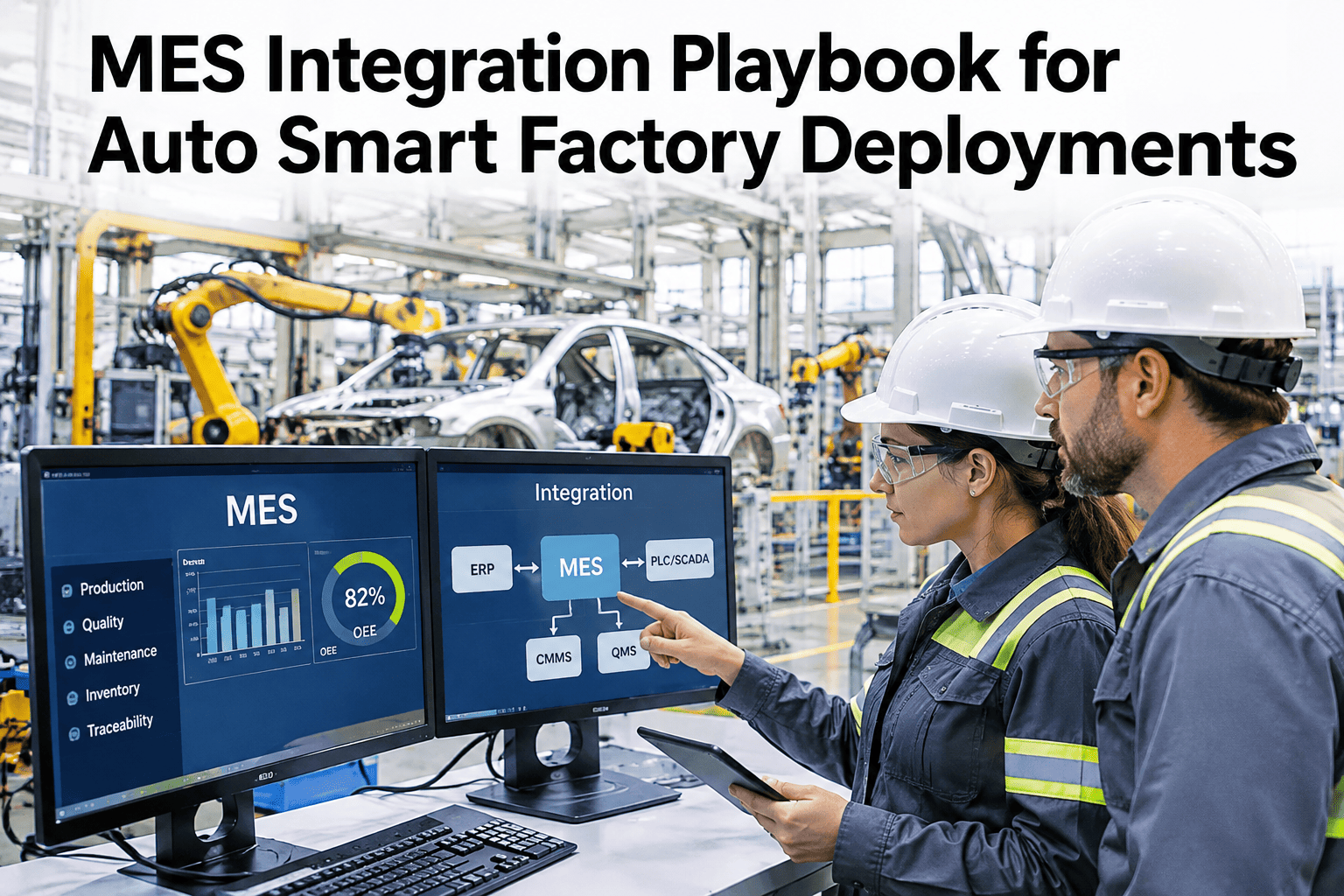
Most MES integrations fail on three handshakes, not one big connection. The MES link goes live, the dashboards populate, and everyone signs off before anyone checks whether order context, product genealogy, and the event bus between them actually survive a messy shift — a rework loop, a split batch, a last-minute spec change. iFactory, an on-premise AI platform for automotive smart factory deployments, builds a checklist around exactly those three handshakes instead of just the connection itself. Walk through the three-handshake checklist.
Three Handshakes. Most Integrations Nail One.
Connecting to the MES is easy. Keeping order context and genealogy intact through every handoff is the actual integration.
Quick Check: Do You Already Know The Answer To These Four?
If any of these four draw a blank, that's the handshake to scope first — not the one that's easiest to connect.
- ACan you name the single authoritative source for order context today?
- BDoes your genealogy model have a documented answer for a rework loop?
- CDo order-context events get priority over routine genealogy writes on your event bus?
- DHas the full chain been tested against a real rework-and-resequence case, not just a clean run?
Order Context: Does The Floor Know What It's Actually Building?
A station that can't see the current order's build spec builds to the last spec it cached — and nothing downstream flags it until a defect shows up.
- Order confirmed in the MES → does the station-level system receive it before the first unit starts, or after?
- Mid-run spec change → does the floor update immediately, or does it finish the batch against the old context?
- Order context source → is there one authoritative source, or does each station cache its own copy that can drift?
Product Genealogy: Can You Actually Trace What Got Built?
Order context says what was supposed to happen. Genealogy has to capture what actually happened — including every rework, split, and re-sequence.
| Event | What breaks genealogy if unhandled |
|---|---|
| Rework loop | The reworked unit loses its link back to the original build record |
| Batch split | Child units inherit no parent-lot traceability |
| Line re-sequencing | Build order in the MES no longer matches the physical build order |
| Component substitution | Swapped part doesn't get recorded against the as-built record |
A genealogy model has to be designed to survive these events — defined up front, not patched in after the first recall traces back to an incomplete record.
Not Sure Your Genealogy Model Survives A Rework Loop?
Send a recent rework or split event — the team will trace it through your current MES record and show exactly where the genealogy link breaks, if it does.
The Event Bus: Carrying Both Without Losing Either
Order context and genealogy are two different kinds of data moving at two different speeds — the event bus has to carry both without one flooding out the other.
- Order-context events → low frequency, high importance — a missed one means the floor builds the wrong thing.
- Genealogy events → high frequency, cumulative — a missed one means a gap in the as-built record that shows up months later.
Both belong on the same bus, but not on the same priority queue. An event-bus pattern that treats every message identically eventually drops the rare, critical order-context update behind a backlog of routine genealogy writes.
The Genealogy Record Was Complete. The Order Context Wasn't.
A trim line receives a mid-shift engineering change — a revised harness routing — pushed from the MES as an order-context update. The event bus delivers it, but it queues behind a burst of genealogy writes from a rework loop two stations upstream, arriving at the trim station four minutes late. In those four minutes, six units are built to the old routing. Every one of them has a perfect, complete genealogy record — it just records the wrong build. The event bus worked. The priority design inside it didn't.
Twelve Checkpoints Across The Three Handshakes
- One authoritative order-context source, not per-station caches.
- Mid-run spec changes propagate before the next unit starts, not after the batch completes.
- Rework loops preserve the link back to the original build record.
- Batch splits carry parent-lot traceability to every child unit.
- Re-sequencing updates the genealogy record to match physical build order.
- Component substitutions are written against the as-built record automatically.
- Order-context events are prioritized ahead of routine genealogy writes on the bus.
- A dropped or delayed event is logged and alertable, not silent.
- Event schema is versioned, so a MES upgrade doesn't silently break the consumer side.
- Genealogy queries resolve fast enough to support a live recall investigation, not just a monthly report.
- A named owner exists for the event-bus schema and priority rules.
- The full chain — order context in, genealogy out — has been tested against a real rework-and-resequence scenario, not just a happy path.
Treating This As One Integration Project Instead Of Three
Teams that scope "MES integration" as a single connection tend to get the easy handshake right and discover the other two in production.
- Order context ships first → looks done, demo works, go-live happens.
- Genealogy gets bolted on later → usually after the first incomplete traceability record surfaces during an audit or recall.
Scoping all three handshakes from the start — with the event-bus priority design included, not assumed — is the difference between a smooth rollout and a sequence of after-the-fact patches.
Three Handshakes Need Three Named Owners, Not One
A single "MES integration owner" title usually means the person who shipped the easiest handshake owns a scope they never fully designed.
- Order context → owned by whoever controls the authoritative spec source, usually production engineering.
- Genealogy model → owned by whoever answers for traceability during an audit or recall, usually quality.
- Event-bus priority design → owned by whoever has to debug it at 2am when something drops, usually controls or IT.
All Three Handshakes Designed Together, Not In Sequence
iFactory's integration team maps order-context flow and genealogy capture against the same event-bus design from day one, rather than treating genealogy as a follow-on project after the MES connection goes live.
- Single authoritative order-context source, pushed to every station before build start.
- Genealogy model designed against rework, split, and re-sequencing scenarios up front.
- Priority-aware event bus — order-context updates don't queue behind routine genealogy traffic.
- On-premise deployment — production and genealogy data stay inside the plant network.
What An Integration Lead Should Verify Before Go-Live
A MES integration is ready when all three handshakes have been tested against a rework-and-resequence scenario, not just a clean single-unit pass.
What Integration Teams Ask About The Three-Handshake Checklist
It's part of the connection, but not automatically kept current — a station can be connected and still build against a stale cached spec. Check how your stations refresh context with the team.
Most MES platforms track the unit's current state well but don't automatically preserve the link back to the original build record through a rework loop unless that's explicitly modeled. Trace a rework event through your current setup.
Yes — order-context updates are rare but critical, while genealogy writes are frequent and cumulative, and treating them identically risks delaying the critical ones. Ask support how priority queues are configured.
Yes — the checklist is designed to audit an existing integration against all three handshakes, not just new deployments. Run it against your current MES with the team.
Scoping all three from the start, rather than patching genealogy in after go-live, is usually faster end to end even though it looks like more upfront work. Get a timeline based on your current MES and line count.
Run The Three-Handshake Checklist Against Your MES
Book a session with the iFactory team and find out where order context, genealogy, or the event bus between them is weakest in your current deployment.